
Talks & Appearances

Pinnacle Conference 2025
Panel SpeakerIn 2025, I joined a panel at the Pinnacle Conference on "Making the Most of the Pinnacle Experience," alongside Dr. Salima Thobani and Dr. Kimberly Hatchett. As a licensed Clinical Mental Health Counselor, I shared how I integrate mental health therapy, yoga, and holistic care to support authentic, sustainable well-being — values that have shaped my own journey as a clinician and supervisor.

Resilience Factor Podcast, 2025Raising Resilient Kids: Mental Health, YouTH SPORTS, AND PARENTING IN THE DIGITAL AGE.
I sat down with Dr. Pamela Mehta to unpack what it really means to raise resilient kids in today’s high-pressure environment. We explored parental roles, stress, anxiety, perfectionism and more.
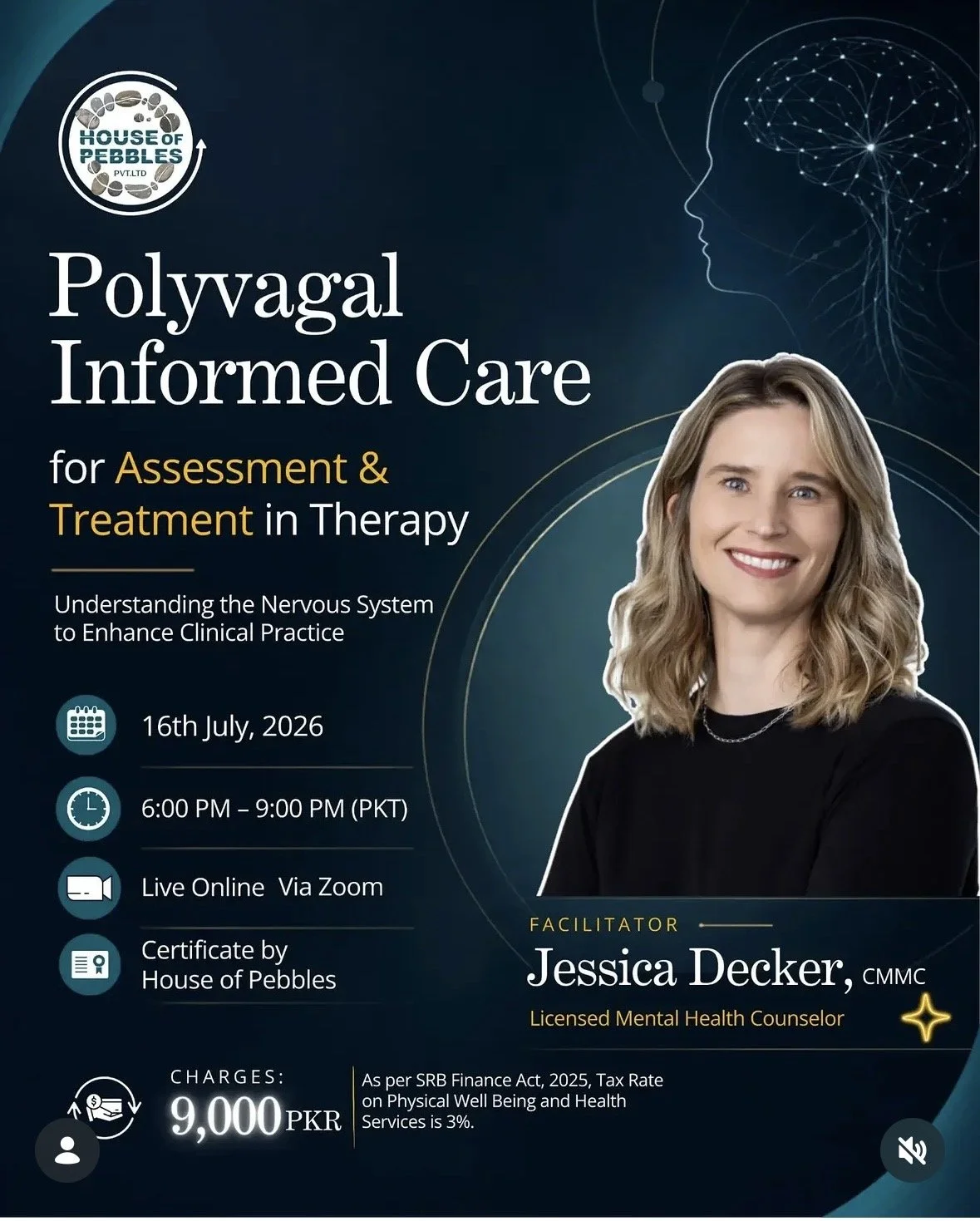
Polyvagal informed care for assessment and treatment in therapy
CE Provider; Spring Health; 2026I presented Polyvagal Theory (PVT) to Spring Health clinicians to strengthen their case conceptualization and treatment approach. Clinicians learned to distinguish the three hierarchical Autonomic Nervous System states and understand behavior as an adaptive nervous system response rather than just a symptom to reduce. I walked through targeted interventions that support a return to the Ventral Vagal (safety) state and had clinicians practice at least three of them, along with assessments that complement the PVT framework — giving them an objective, biological lens to track client progress alongside subjective symptom reports.

CE Provider; House of Pebbles; 2026Polyvagal informed care for assessment and treatment in therapy
This training equips clinicians with the Polyvagal Theory (PVT) framework to strengthen case conceptualization and treatment. Participants learn to distinguish the three hierarchical states of the Autonomic Nervous System and understand behavior as an adaptive nervous system response rather than simply a symptom to reduce. The training covers selecting targeted interventions that support a return to the Ventral Vagal (safety) state, with clinicians practicing at least three such interventions for client use. It also introduces assessments complementary to the PVT framework, giving clinicians an objective, biological lens to track client progress through observable shifts in ANS state — rather than relying solely on subjective symptom reports.